

Winter is the season for preparing various types of pithe, a traditional Bengali sweet made with fresh date palm jaggery. We typically use rice flour, date palm jaggery, coconut, and sooji as the main ingredients. Depending on the recipe, many different ingredients can be added to different pithe.
With Sankranti approaching, it is a tradition for every Bengali household to make Pithe-Payesh. In our family, my mom was regarded as a master at making pithe. I often feel that my pithe-making skills don’t quite measure up to hers, which is a bit disappointing. However, my mom has always had faith in my abilities. Perhaps that’s why she believed I could make perfect Dudh Puli if I tried. Thanks to her blessings, I successfully made Dudh Puli for the first time today! I shared a picture of it with my mom on WhatsApp, and she was overjoyed, praising how good the Pulis looked. Her happiness made my day.
I’m excited to share this recipe with you all, as it is an old family one that was passed down from my maternal grandmother to my mom. Even though I’ve only tried making it once, my mom has made it countless times. This Dudh Puli is easier to prepare than the more popular version, where the puli is made from a rice flour mixture, filled with coconut and jaggery, and then cooked in milk. We absolutely loved this Dudh Puli. If you’re new to making pithe and looking for an easy recipe to try, this is the option to choose. 🙂

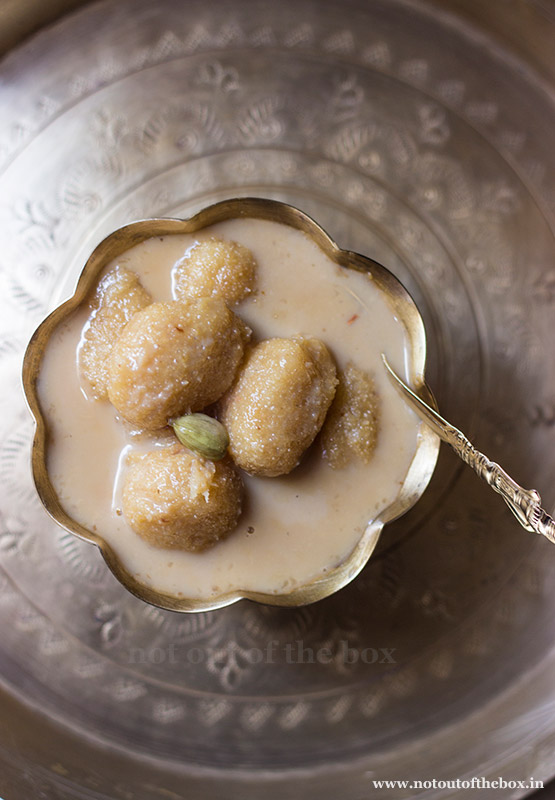
Dudh Puli/Semolina-Coconut dumplings in Sweet Milk
Serves: 5-6
Ingredients
For Puli
- Semolina/Sooji/Rawa- 200g
- Coconut- ½ of one whole coconut (grated)
- Granulated sugar- 150g
- Milk- ¼ cup (approx.)
- All purpose flour/Maida (optional)
For Sweet Milk
- Full-fat milk- 800ml
- Jaggery (Use Patali or Nolen gur only)- 200g or adjust as per your taste
- Bay leaf- 2
- Green cardamom- 4-5 (lightly crushed)
Method
Making of Puli
In a deep frying pan/kadai (non-stick preferably) dry roast sooji on a medium flame for 3-4 minutes. Don’t roast them golden, sooji will change its colour just a bit, roast until then. Now add sugar and grated coconut into this, keep cooking and stirring on medium flame. Sugar will start melting slowly and the mixture will start to change its colour. Now add milk, mix and cook. Take out some mixture at this stage and start rolling using your fingers. If the mixture holds its shape and the sugar granules melted away completely then it’s done.
This part is tricky if you feel that your puli mixture is drying up and sugar granules are still visible add a little milk, add milk carefully because if you ended up adding too much milk the whole thing will become a halwa, so care should be taken at this stage. The perfect puli mixture would be sticky with soft visible sooji grains and no trace of sugar granules, this whole process may take 12-15 minutes of cooking.
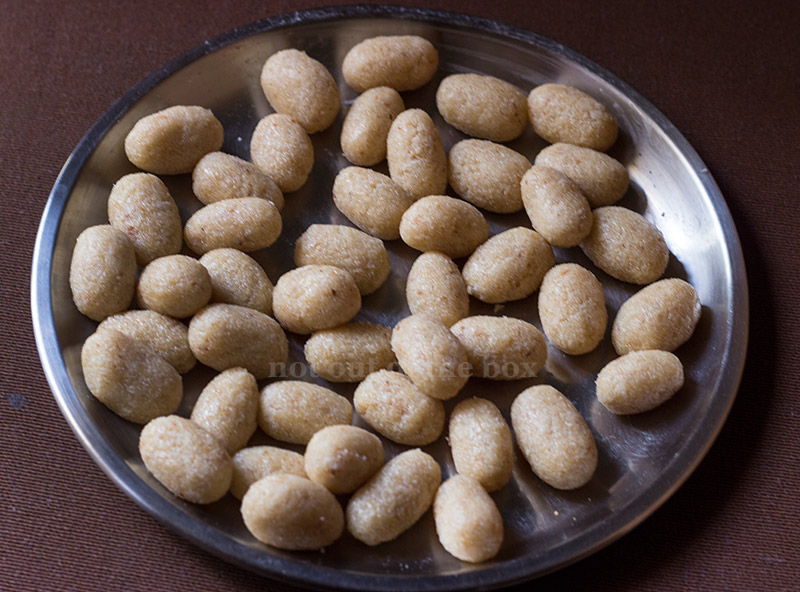
Remove from heat; transfer puli mixture on a plate. Sprinkle some maida on top of the mixture, it’s optional but helps to make the shape of puli perfect. Grease your plums with little ghee/clarified butter and start making puli immediately. Involve others to help you at this as you can only make perfect pulis with warm mixture. Make Pulis in 1” size lengthwise using your fingers and plums. Make the cylindrical shape or make them into half moon shape, as you like. As these were smaller in size I preferred to make them in the cylindrical shape. After making pulis using all the mixture, keep them aside.
Making of Sweet Milk
Break the jaggery in small chunks. Keep aside.
Take a deep bottomed, wide mouth pan. Pour the milk in it. Boil on a high flame. Once it boils, reduce the heat. Add green cardamoms and bay leaves. Keep boiling the milk on a low flame until it comes to ¾ in quantity. Now add jaggery, stir and cook until it melts completely into the milk. Check sweetness, if you prefer more sweet taste you can add more jaggery at this stage.
Now gently add pulis, just give a slow stir to mix them with the milk. Switch off the flame. Let Dudh Puli seat for some time before serving. You can have it warm or serve cold as you like.
Note:
After adding pulis into the milk, no need to cook them further. Otherwise, pulis may break and melt into the milk.





Leave a Reply